- Gibson Les Paul Serial Number Search Free
- Gibson Les Paul Serial No
- Gibson Les Paul Serial Number Search Engine
1947 to 1961. Once the serial numbers hit 99999, Gibson decided to change to a new system, rather than go into 6 digits. The new system used a letter to prefix the numbers. The first guitar in this new system was A 100 which was in April of 1947.
Gibson /1960 Les Paul Special Single Cut Candy Apple Red [2018 Historic Collect]
Brand NewFrom JapanBuy It NowEpiphone Les Paul Classic Black with Bag Serial Number: SU05110851
Pre-OwnedFrom United StatesBuy It NowUsed Epiphone Les Paul Classic Black & Ivory with Bag Serial Number: U04032674
Pre-OwnedFrom United StatesBuy It Now- Brand NewFrom JapanBuy It Now
Vintage Ibanez Agent Custom Les Paul 2405 73-74 Pre serial
Pre-OwnedFrom United Statesor Best OfferGibson 2018 USA Sunrise Burst Les Paul Classic Player Plus Body & Neck
Pre-OwnedTime left1h 6m left0 bidsFrom United StatesVintage Memphis Agent Custom Les Paul 73-74 Pre serial with Ibanez strap
Pre-OwnedFrom United Statesor Best OfferPre-OwnedFrom United KingdomBuy It NowGIBSON USA Les Paul 1960 Classic 'Wine Red + Rosewood' (2005)
Pre-OwnedFrom United KingdomBuy It NowRare 1991 Orville by Gibson Les Paul Custom LPC Gibson USA Pickup Made in Japan
Pre-OwnedFrom JapanBuy It Now43 WatchingGIBSON USA Les Paul Standard LTD 'Pelham Blue + Rosewood' (2011)
Pre-OwnedFrom United KingdomBuy It Now2011 Gibson Les Paul AFD Slash Appetite For Destruction
Pre-OwnedFrom United StatesBuy It Now86 WatchingGIBSON USA Les Paul Custom Shop 1956 Reissue P90 'Goldtop + Rosewood'(2006)
Pre-OwnedFrom United KingdomBuy It NowGibson Les Paul Supreme Signed by Les Paul on 90th Birthday Only 90 made
Open boxFrom Hungaryor Best Offer11 WatchingGibson Custom Shop 2014 Les Paul Custom Ebony w/ Hardcase made in 2014
Pre-OwnedFrom JapanBuy It NowPre-OwnedFrom United StatesBuy It NowGIBSON Les Paul LTD Standard Faded 'Cherry-Burst + Rosewood' (2005)
Pre-OwnedFrom United KingdomBuy It NowGibson Custom Shop 1968 Les Paul Custom Authentic Ebony
Pre-OwnedFrom United Statesor Best Offer1980's GK-55 Les Paul Custom Punk Electric Guitar Project AS IS No Returns!
Parts OnlyFrom United Statesor Best OfferCustoms services and international tracking providedGIBSON USA Les Paul DC 'AAA+ Translucent Amber+ Rosewood' (1999)
Pre-OwnedFrom United KingdomBuy It NowMINTY! Gibson Les Paul Custom Shop Axcess Standard Floyd Rose Iced Teaburst
Pre-OwnedFrom United StatesBuy It NowPre-OwnedFrom United KingdomBuy It NowGibson Custom Shop Collectors Choice #24 Charles Daughtry Nicky 1959 Les Paul
Pre-OwnedFrom United Statesor Best OfferVintage 1962 Gibson Les Paul Junior SG Jr Blue Burst Refin
Pre-OwnedFrom United Statesor Best OfferGIBSON USA LTD Les Paul Standard 'Santa Fe Burst + Ebony' (2004)
Pre-OwnedFrom United KingdomBuy It Now1999 Gibson USA > Les Paul Classic - Mint Condition / with P-90's
Pre-OwnedFrom United StatesBuy It NowEPIPHONE JAPAN Les Paul Standard LPS-90FT HB 2001 Honeyburst MIJ fujigen
Pre-OwnedFrom United StatesBuy It NowPre-OwnedFrom United KingdomBuy It NowOrville Lespaul Custom Les Paul Type
Pre-OwnedFrom Japanor Best OfferOakley Ducati Juliet X Metal Serial Iridium Collectible Rare Elite Bass Les Paul
Open boxFrom United StatesBuy It NowCustoms services and international tracking provided2005 Gibson Les Paul Faded Historic Makeovers
Pre-OwnedFrom United Statesor Best OfferGIBSON USA Les Paul Signature T 'Alpine White Burst + Granadillo' (2012).
Pre-OwnedFrom United KingdomBuy It NowGibson 1996 Les Paul Studio GEM Series ”Ruby' Used in Japan
Pre-OwnedFrom Japanor Best Offer1995 Gibson Les Paul Studio Model W Custom Natural/White Paint Job. Nice
Pre-OwnedFrom United StatesBuy It NowCustoms services and international tracking provided11 WatchingAs one of the oldest and most widely recognized brands in music, Gibson has crafted some of the most cherished and valuable instruments of all time. Determining exactly when your Gibson specimen was made can have high stakes attached to it. A difference of only one year - sometimes even several months - can mean a four-figure difference in value.
Our hope is to make the dating process and, in turn, the valuation as easy, accurate and transparent as possible. You should be able to use this guide to determine the year of your instrument and then consult the Reverb Price Guide to find its value, all for free.
For many vintage instruments, determining the date of manufacture involves little more than running the serial number through a reference guide.
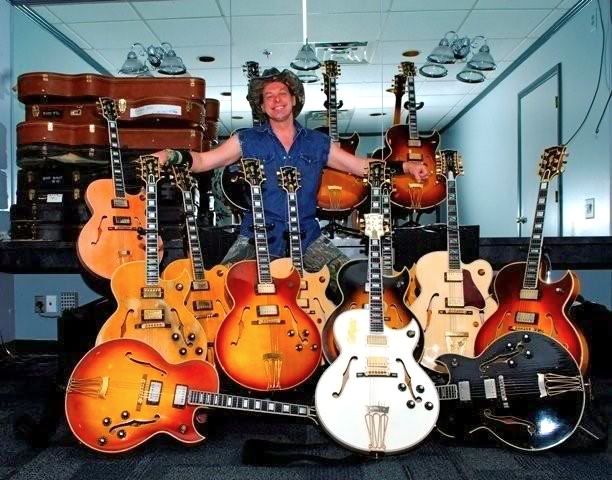
Whereas Martin guitars have been using a single, consistent numbering system since the 19th century, Gibson has used several different serial number formats since its inception in 1902, meaning that some formats and numbers overlap across decades. This makes it especially important to first identify the general era during which your instrument was made before pinning down the exact date of manufacture with a serial number.
If you know the backstory around when the instrument was purchased, this can provide some rough clues about its era. The most general physical piece of evidence on the instrument, however, is going to be the logo on the headstock.
1902 to Late-1920s
The original logo featured the words 'The Gibson' inlaid in pearl at a slant, with an almost hand-written cursive font. This is sometimes referred to as the slanted script logo.
Some earlier specimens from 1903 to 1907 did not slant the logo, or went without a logo entirely. Specimens built before 1902 had a star inlay or crescent in place of a logo.
Late-1920s to 1933
The script logo continues without the slant. Some flattop guitars of this era started to omit the word 'The' from the inlay.
1933 to 1947
By 1933 Gibson had dropped the 'The' from all of their logos while retaining the script 'Gibson.' The original thin script was replaced with a thicker font on higher-end models in the mid-’30s, and across the entire lineup by the end of the decade.
From 1943 to 1947, the logo was a thick golden script, known as the banner logo. Some models (LG-2, J-45, SJ, select L-50s) included an actual banner reading 'Only a Gibson Is Good Enough' in the middle of the headstock.
1947 to Present
The block logo debuted after WWII and remains the face of the company. There were minute changes to which letters were connected in the font between 1961 to 1981, but the main logo had the same look.
1968 to 1972
Gibson stopped dotting the i in their logo on some of their instruments. Most models get a dotted i again in 1972, with the rest following suit from 1981 onward.
Aside from the logos, each era of manufacturing included certain identifying traits such as the hardware (tuners, knobs, plates, etc.), the pickups, the type of finish, and the electronics inside that can give clues as to when an instrument was made. But not a final verdict.
Many older instruments may have reproduction or other non-original parts, including a non-original finish. This makes relying entirely on the physical features of a guitar potentially misleading.
The thickness of the headstock, however, is not as vulnerable to modification or replacement. Before mid-1950, most Gibson headstocks were thinner at the top when looked at from a side profile. After 1950, headstocks had uniform thickness.
Dating a Gibson by Factory Order Number (FON)
Gibson has historically used two different alpha-numerical formats to catalog its instruments: serial numbers and FONs (Factory Order Numbers). Instruments will generally have one or both of these numbers stamped or written either inside the body (generally the case on earlier models) or on the back of the headstock.
FONs were Gibson’s way of internally tracking batches of instruments throughout production. These will generally date an instrument earlier than the serial number, as they were typically applied in the early stages of assembly.
Some earlier lower-end models had no serial number at all, making the FON the sole numerical identifier in those cases. A FON usually consisted of a 3-, 4-, or 5-digit batch number followed by one or two other numbers in most cases.
1902 to 1945 FON Overview
Year FON Batch # Range 1902 - 1916 1 to 3650 1917 - 1923 11000 to 12000 1924 - 1925 11000A to 11250A (suffix included) 1925 - 1931 8000 to 9999 1931 - 1933 1 to 890 1934 1 to 1500 1935 1A to 1520A 1936 1B to 1100B 1937 1C to 1400C 1938 1D to 1000D 1939 1E to 980E 1940 - 1945 1 to 7900 (some with letter, some without) 
From 1935 to 1942, the FON included a letter suffix. The consistency around this stopped during WWII and resumed in the early 1950s.
To complicate matters further, there was sometimes a second letter from 1938 to 1941 indicating the brand (G for Gibson, K for Kalamazoo, W for Recording King) and sometimes even a third letter indicating 'Electric' (the letter E). The year is indicated by the first letter in any series of letters for these years.
1935 to 1942 FON Letter Suffixes
Year FON Letter Suffix 1935 A 1936 B 1937 C 1938 D, DA 1939 Ex (x being any other letter) 1940 F, FA 1941 E (with no other letters) 1941 G 1942 H Throughout the war and even for some time after, each year had its own quirks around FON batch numbers and letters
1942 to 1951 FON Info
Year FON or Letter Code 1942 907, 910, 923, 2004, 2005, 7000s (all with banner logo) 1943 9xx to 22xx 1944 22xx to 29xx (some without FONs) 1945 1xx to 10xx (many without FONS) 1947 700s to 1000s 1948 1100s to 3700s (move from script to block logo) 1949 2000s 1950 3000s to 5000s 1951 6000s to 9000s From 1952 to 1961, a consistent letter code resumed, with the letter appearing before the batch number.
1952 to 1961 FON Letter Prefixes
Year FON Letter Prefix 1952 Z 1953 Y 1954 X 1955 W 1956 V 1957 U 1958 T 1959 S 1960 R 1961 Q Acoustics and Electric Archtops 1902-1961
1902-1947
Gibson’s earliest serialization system was more or less sequential, where each new instrument was assigned the next highest available number. Below is a table of the the highest known number for each production year.
Year Last Numbers 1903 1150 1904 1850 1905 2550 1906 3350 1907 4250 1908 5450 1909 6950 1910 8750 1911 10850 1912 13350 1913 16100 1914 20150 1915 25150 1916 32000 1917 39500 1918 47900 1919 53800 1920 62200 1921 69300 1922 71400 1923 74900 1924 80300 1925 82700 Gibson Les Paul Serial Number Search Free
Year Last Numbers 1926 83600 1927 85400 1928 87300 1929 89750 1930 90200 1931 90450 1932 90700 1933 91400 1934 92300 1935 92800 1936 94100 1937 95200 1938 95750 1939 96050 1940 96600 1941 97400 1942 97700 1943 97850 1944 98250 1945 98650 1946 99300 1947 999999 1947-1961
When the original serial system reached 999,999 in 1947, Gibson started over with an ‘A’ prefix
Year Last Numbers 1947 A 1305 1948 A 2665 1949 A 4410 1950 A 6596 1951 A 9420 1952 A 12460 1953 A 17435 Year Last Numbers 1954 A 18665 1955 A 21910 1956 A 24755 1957 A 26820 1958 A 28880 1959 A 32285 1960 A 34645 Solid Body Electrics 1952-1961
Early Gibson solidbody electrics received a serial stamp on the back of the headstock, with the first number indicating the year of production. The serial number on this Les Paul Junior indicates that it was made in 1956.
1961-1969
Starting in 1961, Gibson implemented a new serialization system designed to cover its entire lineup. However, while the intent was to maintain a more organized catalog, this system in practice achieved the exact opposite.
Numbers from this era were flipped, reused, and in many cases can date an instrument to several non-sequential years. The general system was as follows, though with instruments from this era it’s important to consult key features to get a more accurate age approximation.
Fortunately, Gibson was making more changes to its instruments during the ‘60s and ‘70s than any other period, so dating these instruments by features alone is relatively clear-cut in most cases.
Year Approx Serial Range 1961 100-42440 1962 42441-61180 1963 61450-64220 1964 64240-70500 1962 71180-96600 1963 96601-99999 1967 000001-008010 1967 010000-042900 1967 044000-044100 1967 050000-054400 1967 055000-063999 1967 064000-066010 1967 0670000-070910 1967 090000-099999 1963, 1967 100000-106099 1963 106100-108900 1963, 1967 1090000-109999 1963 110000-111549 1963, 1967 111550-115799 1963 115800-118299 1963, 1967 118300-120999 1963 121000-139999 1963, 1967 140000-140100 1963 140101-144304 1964 144305-144380 1963 144381-145000 1963 147009-149864 1964 149865-149891 1963 149892-152989 1964 152990-174222 1964, 1965 174223-176643 1964 176644-199999 1964 200000-250335 1965 250336-291000 1965 301755-302100 1965 302754-305983 1965, 1967 306000-306100 1965, 1967 307000-307985 1965, 1967 309848-310999 1965 311000-320149 1967 320150-320699 Year Approx Serial Range 1965 320700-321100 1965 322000-326600 1965 328000-328500 1965 328700-329179 1965, 1967 329180-330199 1965, 1967-68 330200-332240 1965 332241-327090 1965 348000-348092 1966 348093-349100 1965 349121-368638 1966 368640-369890 1967 370000-370999 1966 380000-385309 1967 390000-390998 1965-68 400001-400999 1966 401000-407985 1966 408000-408690 1966 408800-409250 1966 420000-426090 1966 427000-429180 1966 430005-438530 1966 438800-438925 1965-66, 1968-69 500000-500999 1965 501010-501600 1968 501601-501702 1965, 1968 501703-502706 1968 503010-503110 1965, 1968 503405-520955 1968 520956-530056 1966, 1968-69 530061-530850 1968-69 530851-530993 1969 530994-539999 1966, 1969 540000-540795 1969 540796-545009 1966 550000-556910 1969 558012-567400 1966 570099-570755 1969 580000-580999 1966-69 600000-600999 1969 601000-601090 1969 605901-606090 Year Approximate Serial Range 1966-67 700000-700799 1968-69 750000-750999 1966-69 800000-800999 1966, 1969 801000-812838 1969 812900-814999 1969 817000-819999 1966, 1969 820000-820087 1966 820088-823830 1969 824000-824999 1966, 1969 828002-847488 1966 847499-858999 1967 859001-880089 Year Approximate Serial Range 1967 893401-895038 1968 895039-896999 1967 897000-898999 1968 899000-899999 1968 900000-902250 1968 903000-920899 1968 940000-941009 1968 942001-943000 1968 945000-945450 1968 947415-956000 1968 959000-960909 1968 970000-972864 1970-1975
Despite being purchased by the Norlin corporation in 1970, Gibson maintained the same confusing 6-digit serial system through 1975, meaning instruments with the same serial number could be from either the ‘60s or the ‘70s.
Fortunately, there were two notable changes to the entire lineup that occurred during the transition that make differentiating ‘60s and ‘70s Gibsons straightforward.
The Volute: c. 1969-c.1981
In 1969 Gibson began carving volutes-- small bumps of additional wood where the neck transitions to the headstock-- to cut down on warranty repair work.
'Made in USA' Stamp: 1970-current
Starting in 1970, ‘Made in USA’ was stamped on the headstock below the serial number.
Gibson Les Paul Serial No
The serial numbers from this period are generally as follows:
Number Year 000000S 1973 100000S 1970-1975 200000S 1973-1975 300000S 1974-1975 400000S 1974-1975 500000S 1974-1975 600000S 1970, 1971, 1972, 1974, 1975 700000S 1970, 1971, 1972 800000S 1973, 1974, 1975 900000S 1970, 1971, 1972 1975-1977
Number Year 99XXXXXX 1975 00XXXXXX 1976 06XXXXXX 1977 1977-Current
Gibson Les Paul Serial Number Search Engine
Starting in 1977, Gibson adopted the current date-based serial system which codes for the year and day of production. The first number of the sequence indicates the decade of production, followed by the three digit day of the year, and finally the year.
For example, the serial number 90237XXX corresponds to a production date of 1/23/97. The last three (or four as of 2005) digits signify the location of production and batch number, respectively, but this information isn’t necessary to accurately dating your instrument.
Working with a potentially very valuable old Gibson can be intimidating, particularly for someone who doesn’t have experience with vintage instruments.
If at any point you feel confused or just want a second set of eyes on your instrument, you can always chat live with a Reverb employee during normal business hours.
Oops, looks like you forgot something. Please check the fields highlighted in red.We understand the importance of online privacy and are committed to complying with the EU General Data Protection Regulation. To reflect our commitment, we updated our terms and conditions. By continuing to use Reverb, you agree to these updates, and to our cookie policy. Learn More